
Last year, 2022, was a year of profound uncertainty in the financial markets. The year started in an orthodox fashion. Then Russia invaded Ukraine and catalysed global inflation. Whether the inflation was just a temporary spike in energy prices or whether a latent long-term inflationary pressure has been unlocked is something still playing out. Whatever the cause of inflation, central banks reacted by ceasing their decade-long near-zero interest rate environment and started to raise interest rates.
Investors reacted to this uncertainty by seeking safe haven by buying US dollars. This meant the dollar appreciated for everyone. Dollar strength was the currency story for most of last year. And this dollar strength impacted the Kenyan shilling. The shilling had been relatively stable for the preceding year at around 105 to the dollar, exhibiting normal market volatility. But, like all other currencies, the demand for dollars started a shilling depreciation.
In the second half of 2022 the risk that everyone was fearing happened as central banks raised interest rates. The reduction in perceived risk meant investors started to step away the dollar, and the dollar started to depreciate. If we look at the dollar against three other major currencies we see the same story: a steady appreciation of the dollar throughout the year, reversing in the last quarter:
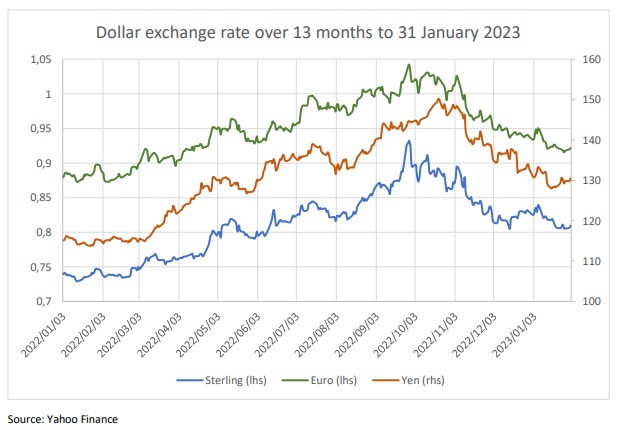
The sterling-dollar history has the further wobble from the short-lived Truss administration in early autumn, but that, and its fall out for both British currency and pension schemes, is a topic for another article. It is a story with important lessons for how pension schemes should, or more pertinently should not, invest.
But if we look at the dollar-shilling history we see a very different story:
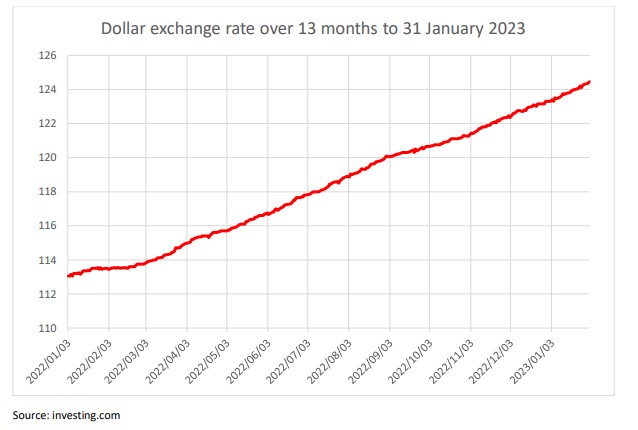
The shilling depreciation has marched on regardless. Many reasons can be explored for this, but the history is unequivocal, and the conclusion is that the shilling did not depreciate last year solely because of dollar strength. There are local factors which are causing the shilling the buck the trend, and which therefore can be expected to continue into 2023. The trend is worth up to 1% per month just for holding – not investing – dollars.
Diversification is often described as the “free lunch” in investment, and with good reason. The portfolios of Kenyan investors should be diversified away from the shilling and the Kenyan economy. Simply put, an optimal portfolio for a Kenyan investor is approximately 50% Kenya and 50% international. Regulatory limits will be constraining in obtaining this portfolio.
Rising interest rates are stoking fears of recession. In January the International Monetary Fund said a third of the global economy will be in recession in 2023. Diversification is always the right investment decision, but especially so during recessionary times. By as allocating as much as possible internationally a Kenyan investor will not only bring diversification and recession mitigation but also pick up a second free lunch courtesy of continuing potential shilling depreciation.
Andrew Slater FIA CFA
Chief Investment Officer


